Friday, May 11, 2018

iMac Pro

Four years since Apple last shipped a desktop Mac with the word “pro” in the name, the iMac Pro has arrived. Holding down the high end of the Mac product line until the day (hopefully in 2018) when a new Mac Pro arrives, the iMac Pro fuses the look of the 27-inch 5K iMac with the priorities of a professional workstation.
This is not a computer designed for the masses—a new iMac Pro starts at $5,000 and you can pay five figures for a high-end model. If you aren’t sure if you need the power of the iMac Pro, you almost certainly don’t. If, on the other hand, you are hungry for multi-core performance and a powerful GPU that will let you crank through intense tasks—in video editing, software development, photo and audio processing, science, graphics, and similar applications—this is the new Mac Pro you’ve been looking for, albeit in the shape of an iMac.

The evolution of the pro Mac

There was a time when most serious Mac users used a professional desktop Mac. The Power Mac line (later renamed the Mac Pro) wasn’t just high end, but mid-range—if you were looking for the cheapest, least powerful Mac you could buy a Performa or iMac, but serious users bought a Power Mac.
Mac Pro & Power Mac IDG
Second-generation (left) and first-generation Mac Pro designs.
But over the past decade, Apple has boosted the power available in the iMac line while positioning the Mac Pro as an expensive product limited to the most high-end work. So many of the Power Mac chauvinists of 2000 became the 5K iMac users of 2015. I’m one of them.
As a result, a “pro Mac desktop” doesn’t mean what it did. There are plenty of mainstream professional users with the need for decent computing power who don’t need to buy anything beyond a 5K iMac. Still, there are a bunch of tasks that require pushing the edges of performance beyond what the 5K iMac can provide. And I have to admit, lately I’ve realized that I don’t fit comfortably in that category either: The more video editing and audio work I do, using software that maxes out my iMac’s processor cores and still takes excruciatingly long to finish doing its work, the more I come to desire faster processors, more cores, and faster storage. The iMac Pro delivers all of that.

It’s what’s inside that counts

When I swapped my 2014 5K iMac for an iMac Pro, my workspace didn’t change much. At a glance the iMac Pro is just an iMac (with a 27-inch 5K display with support for the full P3 color gamut) in a slightly darker shade of silver. (And yes, the peripherals supplied by Apple—a wireless keyboard with number pad, mouse, and optional trackpad—are available in the same Space Gray shade, for now only with this computer.) Inside, though, this is not like any iMac ever before made.
I bought and tested the $4,999 base model, which is powered by an 8-core 3.2GHz Xeon W processor. (Apple’s also offering 10-, 14-, and 18- core versions.) The base Xeon W supports Turbo Boost up to 4.2GHz, which is useful when you’re stuck with particular programs that aren’t written to spread the processor load out across multiple processor cores. The base-model iMac Pro also comes with 32GB of RAM (configurable up to 128GB) and 1TB of SSD storage (configurable up to 4TB). And the biggest powerhouse in the system might be the Radeon Pro Vega GPU.
About that RAM: The iMac Pro’s RAM slots are upgradeable, but only by Apple or an authorized repair center. To get in to upgrade the RAM, someone’s going to have to pull the display off. As a result, if you buy an iMac Pro you should buy it with the amount of RAM you expect to need for the next year or two. But the good news is, if you do need more RAM later, the iMac Pro is upgradeable. It’s just not an easy upgrade as it is on the 27-inch 5K iMac.
The SSD storage on the iMac Pro is actually two striped banks of NAND memory controlled by an Apple-designed T2 processor. (More on the T2 in a bit.) According to Apple, the SSD in the iMac Pro can read at up to 2.8GB per second and write at up to 3.3GB per second. It’s really quite fast.
imac pro ports
Roman Loyola
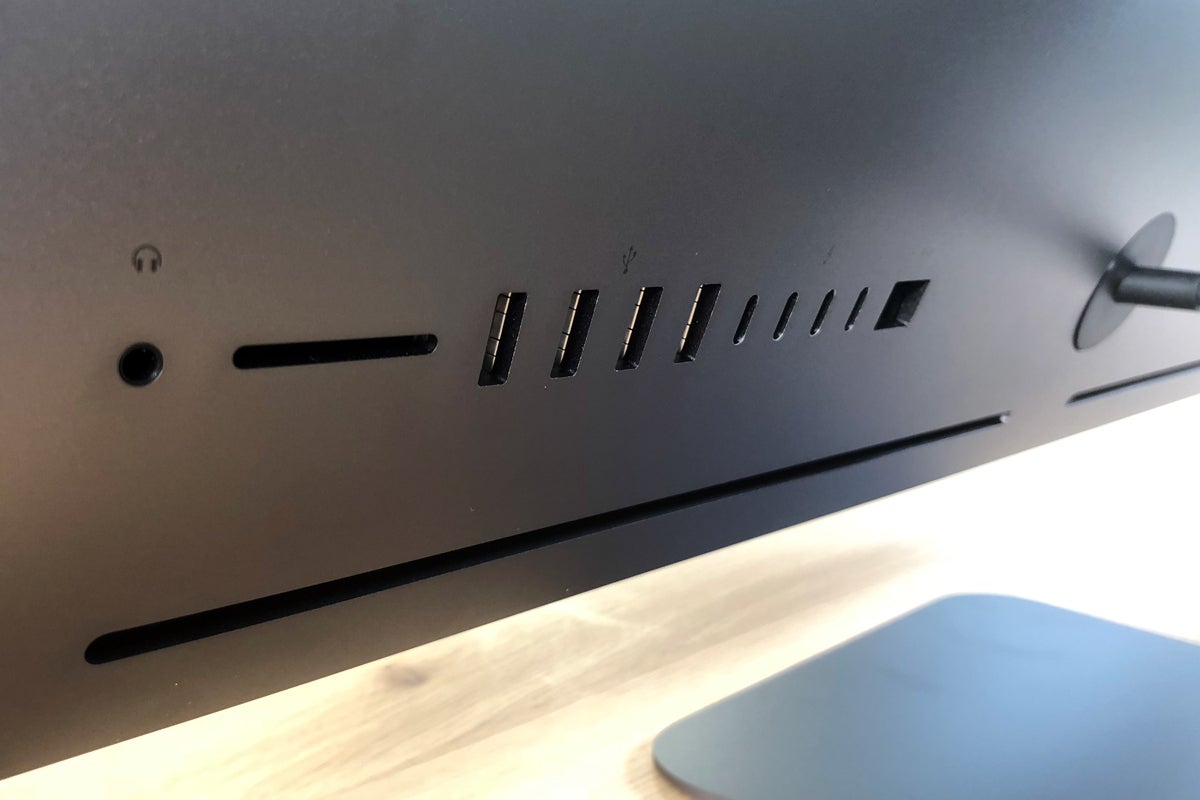
iMac Pro ports (left to right): headphone, SD card, 4 USB 3 ports, 4 Thunderbolt 3/USB-C connectors, 10Gb ethernet.
On the outside, beyond the Space Gray coloring, the biggest upgrade from the 5K iMac is probably in the content and quality of the ports on the back of the iMac Pro: There are four Thunderbolt 3/USB-C ports on two independent controllers, allowing for high-speed external connectivity. The iMac Pro can drive two external 5K displays, which is mind-blowing. (It’s worth noting that if you rely on Thunderbolt peripherals or have existing external monitors, you’ll need to buy adapters to get them to work with the iMac Pro.) The iMac Pro’s ethernet port can support speeds up to 10 gigabits, which would be great for making networked storage feel like local storage. (I only have gigabit ethernet in my office, alas.)
As someone who has spent the last three years with my iMac floating above my desk, courtesy of a VESA mounting arm, I’m delighted to report that the iMac Pro returns to the mounting flexibility of iMacs before the previous generation. You can remove the iMac Pro’s included stand and, with the purchase of a $79 adapter, attach it to any standard VESA mount on a wall or arm. (The 4K and 5K iMacs can be purchased in stand or VESA versions, but you can’t convert them after the fact to the other configuration.) The iMac Pro is floating above my desk right now, and looking great doing it. (Learn more about mounting the iMac Pro on a VESA arm.)

Fast facts: iMac Pro benchmarks

I tested the iMac Pro against my existing 5K iMac (the original 2014 model with an SSD, 16GB of RAM, and a 4GHz Intel Core i7 processor) as well as, for some tests, a 2017 5K iMac with a 3.6GHz Intel Core i7. I tried to run real-world tasks, the sort of thing that I bought the iMac Pro to do faster than my old iMac. These were largely tests involving audio processing and operations in Logic Pro, exports from Final Cut Pro, and some other video and audio processing tasks.
On the video side, I encoded a 1080p MKV video file into H.264 using HandBrake. On the audio side, I removed background noise from a three-hour-long audio file using iZotope RX 6’s Spectral Denoise feature, synced audio with the unreleased sidetrack sync tool, encoded a podcast MP3 using Marco Arment’s Forecast, and bounced a 24-track, 22-minute-long Logic Pro project with numerous track effects.

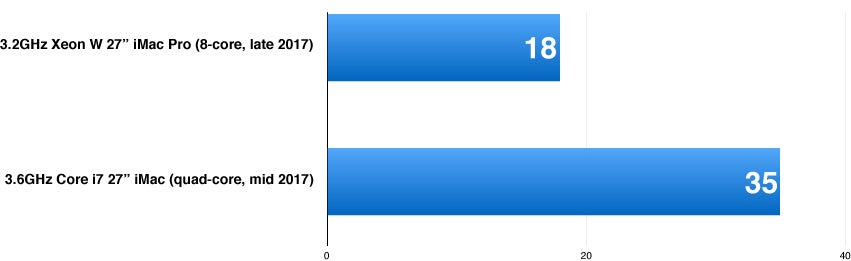
iMac Pro benchmark test: Forecast MP3 encode
forecast mp3 imac pro
IDG
Results in seconds. Shorter bars/lower results are better. Click to enlarge.

iMac Pro benchmark test: GeekBench Compute GPU

geekbench compute gpu imac pro
IDG
Results are scores. Longer bars/higher results are better. Click to enlarge.

iMac Pro benchmark test: GeekBench Multi-Core

geekbench multi imac pro
IDG
Results are scores. Longer bars/higher results are better. Click to enlarge.

iMac Pro benchmark test: GeekBench Single-Core

geekbench single imac pro
IDG
Results are scores. Longer bars/higher results are better. Click to enlarge.

iMac Pro benchmark test: HandBrake encode

handbrake imac pro chart
IDG
Results in seconds. Shorter bars/lower results are better. Click to enlarge.

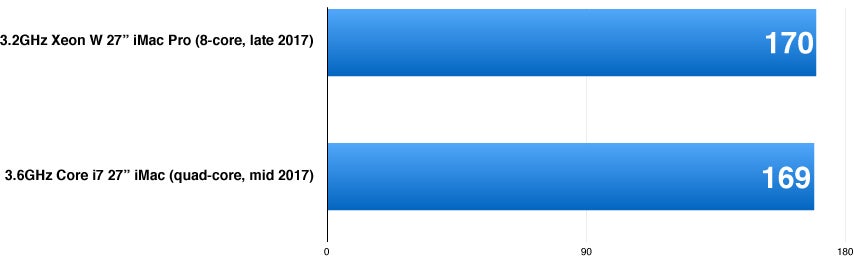
iMac Pro benchmark test: iZotope De-Echo
izotope de echo imac pro
IDG
Results in seconds. Shorter bars/lower results are better. Click to enlarge.

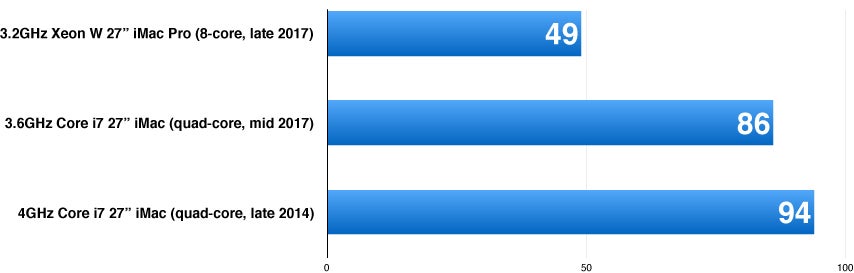
iMac Pro benchmark test: iZotope Spectral Denoise B
izotope spectral denoise 8 imac pro chart
IDG
Results in seconds. Shorter bars/lower results are better. Click to enlarge.

iMac Pro benchmark test: Logic Bounce

logic bounce imac pro
IDG
Results in seconds. Shorter bars/lower results are better. Click to enlarge.

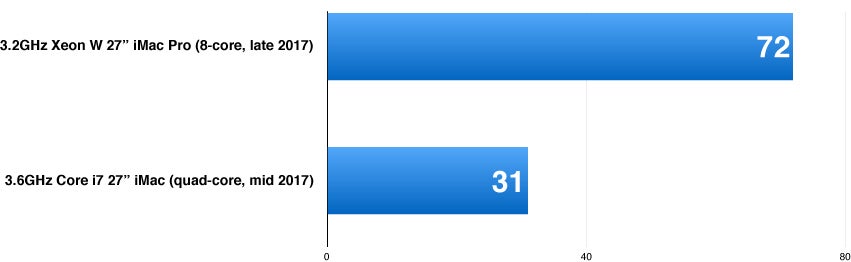
iMac Pro benchmark test: Unigine Valley (High)
unigine valley imac pro
IDG
Results in frames per second. Longer bars/higher scores are better. Click to enlarge.
For tasks that can take advantage of multiple processor cores, the iMac Pro performed tasks in half the time as the 2014 i7 5K iMac and 60 percent of the time of the 2017 i7 5K iMac. Put simply, for 5K iMac users this will be huge a leap forward in terms of multiprocessor performance. (And as you might expect, graphics performance is also spectacular, thanks to that Radeon Pro Vega GPU.)
When it comes to single-core performance, however, the Xeon processors in the iMac Pro don’t have much of an opportunity to shine. The iMac Pro offered roughly the same single-core performance as my three-year-old i7 5K iMac, and a 2017 5K iMac would undoubtedly outshine it on those tests. If the work that you do is largely confined to a single processor core, the iMac Pro is not the product for you. You’d be better off with a 5K iMac, which will be faster at those tasks—and a lot cheaper, too.
(I’ve seen some reports about how the Xeon processor doesn’t have the same video-encoding powers as the Core i5 and i7 processors in other Macs. This is accurate, in that Intel’s consumer chips include media blocks that provide accelerated video encoding, and the Xeon doesn’t. The AMD Vega GPU, on the other hand, does offer a media block for video encoding—so that’s what the iMac Pro uses. In my tests, video encoding was extremely fast on these systems, so not to worry.)

The hybrid Mac

As I wrote earlier this month, the iMac Pro notably includes an Apple-designed ARM processor, the T2, to manage numerous tasks previously done by separate controller components. This isn’t the first Mac to mix an Apple-designed ARM chip with an Intel processor—every MacBook Pro with Touch Bar comes with the T1 chip—but the iMac Pro’s T2 augurs a future where the Mac is made more secure and efficient thanks to an Apple-built helper chip that works alongside the CPU and GPU.
The T2 controls the iMac Pro’s stereo speakers, internal microphones, and dual cooling fans. It provides an Image Signal Processor for the upgraded 1080p FaceTime camera, and it shows—the image quality of that camera is dramatically improved over previous iMac cameras. Most impressively, the T2 acts as the system and disk controller, driving two banks of NAND memory that serve as the iMac’s internal SSD and seamlessly encrypting all data stored to disk.
But of course, you wouldn’t know that the T2 is in there if you weren’t alerted to its presence. The iMac Pro works like you’d expect a Mac to work, with the exception of a few new security features. Booting up the iMac Pro first allows the T2 to take control and verify that everything’s on the up and up. (By default it won’t start up from a version of macOS that hasn’t been blessed by Apple, or via an external disk—both options you can change by booting into Recovery mode and launching the new Startup Security Utility. Users of Boot Camp will be happy to know that Apple also honors Microsoft’s signing of Windows 10 beginning with the 2017 Fall Creators Update.)
This is the first iMac Pro and the first Mac with a T2, and I wasn’t surprised to notice a few quirks. A few times, I’ve entered my password on startup, only for that entry to be greeted with a bounce animation indicating that the password was entered incorrectly. After a few seconds, the iMac Pro would continue logging me in—so apparently my password was correct after all? Strange. I also failed twice to install Boot Camp before it finally succeeded.
Speaking of the fan on the iMac Pro, it’s worth taking a moment to consider the cooling system in the iMac Pro. Now, as someone who has only used the 8-core model, it’s safe to say that I haven’t seen the amount of heat that can probably be put out by the 18-core version. What I can say is that the iMac Pro’s fans are whisper quiet—even in a quiet room I couldn’t really hear them unless I stuck my ear up to the back of the iMac Pro. And when under load, the fans didn’t audibly rev up as they do on the 5K iMac. In fact, the only really sign that the iMac Pro was under load was that the air blowing out the back was warmer.

Bottom line

The iMac Pro is a Mac Pro in the body of a 5K iMac. If you’ve been using a 5K iMac but desperately need better performance from software that’s aggressively multithreaded, the iMac Pro will supply that performance. (If your go-to software does not take advantage of those extra cores, this isn’t the Mac for you). While we don’t know anything much about the forthcoming Mac Pro, it will presumably be more customizable than the iMac—especially when it comes to external displays—while the iMac Pro will more or less remain what it is today.
What it is, today, is the fastest Mac around, with fast processors, storage, and connectivity, all attached to that gorgeous 5K screen. If you aren’t sure if you need an iMac Pro, you probably don’t. But for those of us who can put the 8, 10, 14, or 18 cores in iMac Pro to work, along with the Radeon Pro Vega GPU and the fast SSD storage, it’s an amazing combination of Mac Pro and 5K iMac.

iPhone 6 and iPhone 6 Plus


AT A GLANCE
  • Apple iPhone 6 Plus

  • Apple iPhone 6

When Apple released the first iPhone, its 3.5-inch touchscreen seemed huge compared to the displays of other phones. Nonetheless, competitors responded with even larger screens, trying to find areas where they could provide clear alternatives to Apple hardware. Consumers responded positively, so the competition started making even bigger phones.
Whatever good reasons Apple had for sticking with its 3.5-inch (and later 4-inch) screens—and there are good reasons, including the fact that it’s hard to hold and control larger phones—it also meant it was ceding the large end of the market to the likes of Samsung.
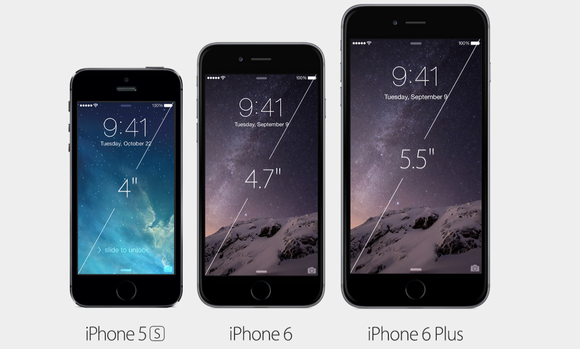
The iPhone 6 and 6 Plus are Apple’s reply to the success of large Android phones. The iPhone 6 measures 4.7 inches, while the iPhone 6 Plus comes in at 5.5 inches. Both models will help Apple reach an audience that just wasn’t being served by the 4-inch iPhone 5s and 5c—though the company also risks alienating people who actually preferred the smaller screens.

Twin wonders

The iPhone 6 and iPhone 6 Plus are essentially the same device, with differently sized displays and only a few minor internal variations. The phones' release marks the first time Apple has launched two entirely new iPhones simultaneously, as last year’s iPhone 5c was really just an iPhone 5 with a different body.
Hold an iPhone 6 in your hand for the first time, and you can tell it’s a very different device from the iPhones of the past four years. Gone is the more industrial feel of the iPhone 4 and 5, with their straight sides and chamfered edges. The new phones have rounded edges, more akin to the iPod touch, iPad, and even the very first iPhone.
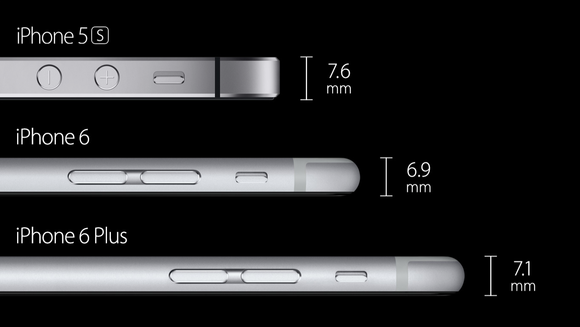
iphone 6 thickness comparison
The iPhone 6 and 6 Plus are each thinner than the 5s.
If the iPhone 6 used the same design as the iPhone 5, but were larger, it would feel immense. But even though the iPhone 6 is slightly heavier than the iPhone 5, its curved edges (not just the metal, but the edges of the glass front are curved) and thinness save it from feeling like an oversized monstrosity. After a few days, I found I had unconsciously changed the default position of my fingers when holding the phone, and using it felt entirely natural.
Then there’s the iPhone 6 Plus. While I wouldn’t call it an “oversized monstrosity,” it’s definitely huge. As with the iPhone 6, the iPhone 6 Plus’s thinness and curved edges do offset the extra size somewhat. However, you will never mistake the iPhone 6 Plus for the iPhone 6. It’s three-quarters of an inch (or roughly 14 percent) wider. In my average-size male hands, I found I could hold the iPhone 6 Plus, and manage to get my thumb to reach across the screen, at the very bottom, if I concentrated. But beyond looking at the huge screen and doing some simple gestures, this seems to be a device that’s made for two-handed operation.
That’s not necessarily bad—I often use my iPhone two-handed, though sometimes I casually flip through it with one hand, and that wouldn’t happen were I to sport the iPhone 6 Plus. For people with large hands, it’ll be less of an issue. I also discovered, to my surprise, that the front pockets of my Levi’s jeans were able to hold the iPhone 6 Plus without any problem. Your pockets may vary, but I was able to tote a 6 Plus in the same pocket that I usually carry my iPhone 5. While the feel was different, it wasn’t ridiculous.
iphone 6 size comparison
The iPhone 6 is noticeably larger (to the eye and in the hand) than the 5s; the 6 Plus is way, way more so.
That being said, the iPhone 6 Plus is unlike any iPhone before it. Not quite a phone, not yet an iPad, it’s a tweener of a device that’s going to be fantastic for some people and completely wrong for others. In Asia, this size of device is quite popular—for many people, phablets are their only computing devices, so the large screen is a huge productivity boost. And if you’re someone who would really rather not have an iPad, a larger iPhone makes sense. And if you’re someone for whom bigger is always better, why not get the biggest iPhone around?
If you don’t find yourself nodding at that sentiment, I strongly suggest that you visit an Apple Store or another retailer that stocks the iPhone 6 Plus, hold it in your hand, and try it out. It’s really a different class of device, and I fear that a lot of people are going to rush into buying one without having a sense of the scale of the thing.
Beyond the curved sides and two sizes, there are numerous other hardware design changes that Apple has introduced with the iPhone 6. The iPhone 5’s round volume buttons have been replaced with thin metal ovals set into a slightly recessed indent just below the silence switch. The sleep/wake button has retreated from the phone’s top (thus completing the evacuation—there’s nothing left up there), and moved to the right side, a first for an iPhone. For longtime iPhone users, it’s going to take some getting used to, but on larger phones it’s harder to reach that top edge, hence the change. I still haven’t gotten used to it.
iPhone 6 and 6 Plus have raised cameras. Jason Snell
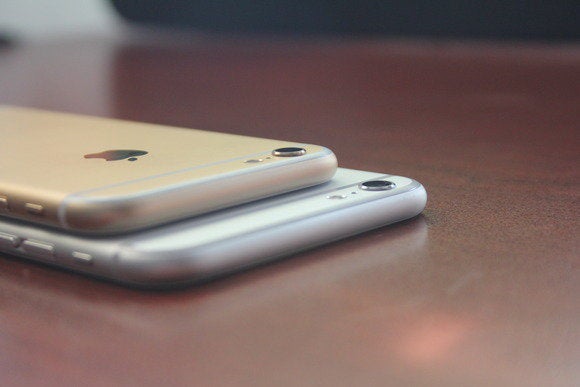
The iPhone 6 camera extends slightly from the back. Note the ring around the lens.
On the back of the device, the most noticeable change is that the camera now extends outward a bit, its lens surrounded by a thin metal ring. It’s a subtle change, and you can still place the iPhone flat on its back with a minimum of rocking. But it definitely won’t be perfectly level.

It’s what’s on the inside

The exterior design of the iPhone 6 line marks a change for the iPhone product line, but these models also come with some internal hardware upgrades. They’re powered by the new Apple A8 chip, the latest in a long line of chips Apple designs itself, optimized for its own hardware.
The jump to the 64-bit A7 processor last year brought a massive increase in performance to iOS devices. In fact, the A7 offered so much speed improvement, there was no way that the A8 could match the same percentage increase. It’s definitely faster than last year’s processor, but by a more modest amount. Apple’s chart of iPhone performance, which had been depicting exponential growth, shows signs of slowing. (However, it's worth noting the A8 chip uses a smaller manufacturing process, and is much more power efficient than the previous model.)
GeekBench (Single-Core)
  • iPhone 6 Plus1610
  • iPhone 61517
  • iPhone 5s1409
Higher scores/longer bars are better.
GeekBench (Multi-Core)
  • iPhone 6 Plus2877
  • iPhone 62586
  • iPhone 5s2549
Higher scores/longer bars are better.
Apple claims that the iPhone 6 has slighty better battery life than the iPhone 5s, and that the iPhone 6 Plus has quite a bit better battery life than that. Unfortunately, I didn’t have time to run comprehensive battery tests for this review, and of course battery life can vary massively depending on how you use the device. That said, after spending a long weekend with the two devices, I can corroborate Apple’s claims.
The iPhone 6 definitely appeared to have longer battery life than my iPhone 5s—though, to be fair, that iPhone has been in use for a year, and so its battery isn’t fresh. The iPhone 6 Plus definitely seems to be the longest-lived iPhone so far, but does its battery last long enough to obviate the need for a battery case or external battery for emergencies? I just can’t say quite yet.
Apple says that the iPhone 6 and 6 Plus also sport a new version of its motion coprocessor, the M8. This chip collects sensor data as you use your iPhone, even if the A8 processor is resting. The new version takes advantage of the iPhone 6 line’s barometer, a sensor that lets it gauge elevation changes—such as when you’ve climbed up a flight of stairs.
Finally, these are the first iPhones to support Near Field Communication, or NFC, as a part of the forthcoming Apple Pay service. There’s a Whole Foods a short walking distance from my house, and I’m looking forward to buying peanut butter and beer by moving my iPhone 6 to within an inch of the NFC reader, using Touch ID to verify my identity, and then taking off. But because Apple Pay won’t work until October, I couldn’t test that feature now.

On displays

Apple has dubbed the screen on both iPhone 6 models “Retina HD,” a strange and somewhat redundant label. In reality, the iPhone 6’s 4.7-inch display has the same screen density (326 pixels per inch) as the iPhone 5 line. The pixels aren’t packed any tighter on the iPhone 6—there are just more of them, because the screen is 110 pixels wider and 198 pixels taller.
The iPhone 6 Plus is a different story. Its 5.5-inch screen (measured diagonally) has a resolution of 401 pixels per inch, the most ever on an iOS device. That means it’s a full 1080p display—the equivalent of a high-definition TV in your (biggest) pocket.
Before we go on, a note about resolutions and scaling, since it can get a little complicated. There are really two ways to measure displays: How big they are (inches) and how many individual dots they can contain (pixels). When we talk about a display’s pixels per inch, we’re describing how small the dots are—effectively, how many of them are packed in any square-inch of a display. These days, most TVs have exactly the same number of dots: 1080 rows and 1920 columns, or roughly 2 million dots. On a 60-inch TV, they’re just less densely distributed than on a 40-inch model. And that same resolution on the iPhone plus is packed into a 5.5-inch space—it’s effectively a 5.5-inch HDTV.
In fact, the iPhone 6 Plus so large and so densely packed with pixels that it has actually caused Apple to change the way it handles drawing on its screen. Borrowing a technique Apple used on the MacBook Pro with Retina Display, the iPhone 6 Plus actually renders its interface at 2208 by 1242 pixels. This is a resolution that scales linearly from the displays used on previous iOS devices, which is perfect—except that the iPhone 6 Plus’s screen only measures 1920 by 1080 pixels! So to make the entire image fit, the iPhone 6 Plus reduces the entire interface—scaling it down to 1920 by 1080—in order to make it fit on the display.
scaled unscaled
You can tell you’re running an upscaled app (above) because the menu bar and keyboard look larger than they do on regular apps (below).
Scaling displays used to be something that simply wasn’t done, because it can create weird artifacts and fuzziness (and requires a lot of graphics power). If you’ve ever tried to use a non-Retina Mac display at a non-native resolution, you know what I’m talking about. But the thing about Retina displays is, the individual pixels are so small that most of the fuzziness is happening on a scale that’s just too small to see. The display of the iPhone 6 Plus, like that of the Retina MacBook Pro, looks just fine—despite a whole lot of hardware and software working hard behind the scenes to make sure the math adds up.
An advantage of embracing scaling on high-resolution devices is that Apple can apply it in other ways, too. Apps that haven’t been updated for the iPhone 6’s larger displays simply scale up to fit the new size. Everything’s just a bit bigger, and if you look carefully you can notice the difference, but the apps still work just fine.
Apple has also added a feature called Display Zoom that’s essentially the software version of those “large-print edition” books used by people with vision problems. When you turn Display Zoom on, the phone emulates the display of a smaller phone and then scales it up to full size. This is a great feature for anyone who feels like the content on their iPhone is just too small. It also means that while these phones are bigger, that bigness can either provide more room or just make everything larger. We all get to pick. Nicely done.
Without Display Zoom turned on, these devices have enough extra screen real estate for Apple to add new columns of buttons to the sides of the standard iOS keyboard—but only when held in landscape orientation. (In portrait orientation, the keyboard feels a bit bigger, but it’s still the standard iPhone keyboard.) In landscape mode on the iPhone 6 Plus, the left side of the keyboard lets you cut, copy, paste, bold text, and undo an action, in addition to triggering international or Emoji keyboards and voice dictation. On the right side of the keyboard, you can move the cursor forward or backward, add an exclamation point or question mark, comma or period.
keyboard extensions
A bigger screen also means a keyboard with extra features, as seen on landscape views of the iPhone 6 (above) and iPhone 6 Plus (below).
On the iPhone 6, which is quite a bit narrower than the iPhone 6 Plus, the additional commands are an undo button and a comma on the left side, and cursor keys and a period on the right side. (Since these phones also run iOS 8, they also offer the new optional QuickType suggestion bar at the top of the keyboard, and will support third-party keyboards if you don’t want to use the default.)